Saturday, January 7, 2012

Spirited Away: The Insufficiency of Western Capitalism Part I

Contrary to popular opinion, animation is not limited to mind-numbing, simplistic narratives which only serve as a source of entertainment for young children. Indeed, animation can be an incredibly expressive artistic medium. Renowned Japanese filmmaker Hayao Miyazaki’s recent masterpiece, Spirited Away, is one such animated movie which showcases the medium’s hidden potential to subconsciously or consciously shape our epistemological outlooks. After all, the manipulation of the viewer’s thought process via a stylized experience is the apex of any artistic medium. Spirited Away follows a young ten year-old girl named Chihiro Ogino as her family moves to a new neighborhood. Chihiro soon finds herself abandoned in a world of spirits and monsters after she and her family venture into a seemingly abandoned amusement park where her parents are morphed into pigs by a witch named Yubaba. With some help, Chihiro begins working in Yubaba’s bathhouse in order to find a way to free herself and her parents before returning to the human world.

While marketed in America by Disney as a coming of age narrative, Spirited Away is much more valuable as a critical commentary on modern capitalism in Japan. This message comes as no surprise from director Hayao Miyazaki whose previous films, including “Nausicaa of the Valley of the Wind,” often feature powerful messages about capitalist-driven ecocide. However, Spirited Away is unique, serving as Miyazaki’s first effort at exposing the power dynamic capitalism has forged between Japan and the West from a historical perspective. An analysis of Spirited Away via a Marxist lens is valuable insofar as it allows us as viewers to more comprehensively understand how the film depicts modern capitalism. Through such depictions, Spirited Away sheds light on how we as individuals should operate within a system of global capitalism, the dangers associated with monetary power hierarchies, and the insufficiency of capitalism as a sustainable and desirable framework.

THE DYNAMIC BETWEEN JAPAN AND THE WEST


Perhaps most of all, Spirited Away soberly exposes the consequences associated with Japan’s early integration into the web of global capital. Just as Chihiro and her family, the viewer is pulled back to an era of modernizing Japan, the Meiji era (1868-1912), by Miyazaki as the camera passes the gates into the spirit world. The warp is stylistic, becoming immediately noticeable as Chihiro and her family stumble into a run-down bazaar featuring a Meiji-characteristic mixture of Japanese and Western architecture. During the Meiji period, Western influence began to crack Japan’s national, political, and economic solidarity, occurrences spawned from Commodore Perry’s infamous “negotiations” in 1853. As Japan opened its economy to Western nations, global capitalism became invariably rooted within its borders. Beyond an economic level, Japanese social modesty began to give way to a new sense of industrial-driven greed and materialism.

For many, including Miyazaki, Japan’s integration with the West represented a significant loss of cultural identity, bestowing upon Japan a perpetual role of international dependence. In Spirited Away, Miyazaki heavily emphasizes the importance of having a proper name as a prerequisite for identity. When Chihiro approaches Yubaba looking for work, Yubaba agrees only after pillaging her name with her magic, replacing it with her own creation: Sen. Sen, meaning 1000 in Japanese, is indicative of how Chihiro’s individuality and intrinsic worth have been reduced to a monetary value by Yubaba. Name is the foundation of individuality, and indeed, we experience an omnipresent danger of losing our identity as members of modern capitalism. Just as Chihiro, Japan forever lost its cultural identity post-integration. Spirited Away showcases such loss, emphasizing a modern disinterest in ancient values in contemporary Japan and depicting previously noble Shinto spirits, yaoyorozuno kamigami, as mere consumers within the Yuya.

Within the Yuya, or spirit world bathhouse, Yubaba’s dominance over its inhabitants symbolizes the power dynamic between the West and Japan. There is a noticeable divide between Yubaba and her workers. Yubaba’s luxurious office, replete with jewels and gold, is decorated with Western décor, including Victorian wallpapers, exotic carpets, and European woodwork. Even Yubaba herself sports a blue, Western dress while her workers are clad in Japanese bathhouse uniforms and kimonos. The workers’ quarters are shockingly minimalist and humble, designed along the lines of Japanese architecture additionally. Not only does Yubaba dominate her workers monetarily, but her magic aids in her coercion. Apart from powerful spiritual patrons, representing wealthy nations whose patronage primarily benefits Yubaba, Yubaba has a monopoly on magic within the Yuya. This dominance is indicative of Japan’s powerless position in relation to the West; no matter how economically powerful Japan becomes, it will always psychologically be dominated by the West.

Friday, December 30, 2011

The Dynast-King's Legacy

Dear Followers,

Phew. Thankfully I have last minute memory skills and remembered to return my PSEO textbook before I was charged. So clutch. As I walked out of Coffman, snow flakes slowly dancing to the ground, I couldn't shake an overwhelming feeling of emptiness. Usually the U is bustling with activity, with college kids flooding the walkways and chatter filling the air. This is one of the few holidays I have spent at home, so I guess I'm not really used to such a vacancy. I can't help but wonder if everybody went back home or if they were just tucked away in the Stadium Village restaurants. I could really go for some Cane's fried chicken right now.

Back home my PS2 waits for me, Final Fantasy XII loaded in the disk tray, ready for action. Speaking of which, Final Fantasy XII gets bashed like crazy on forums for some reason. As far as I'm concerned, Final Fantasy XII is incredibly underrated. The game is expansive. Not only does the main story run for a good 40-50 hours, but the amount of side quests, optional hunts, and unlockable secrets could easily keep you busy for 100+ hours. While many complain about the Active Dimension Battle system, I find the ability to freely roam and engage monsters without having to endure annoying load screens or battle cinematics incredibly liberating.


While many play off the Gambit system as an uninteractive way of conducting combat, the system brings, for me, a whole new level of customization to each of your characters which allows you to shape them into specific roles like never before. In addition, mixing and matching gambits in order to optimize your combat abilities involves an immense amount of planning, experimentation, and strategizing. Apart from the actual gameplay however, I find the world of Ivalice to be fascinating. The dialogue in Final Fantasy XII, playing on anachronistic speech mannerisms and folklore, is engaging and creatively unique. In addition, the mixture of characters within and outside of your party create a very functional narrative dynamic.

After a journey through the Pharos with what I consider the best party in terms of raw statistics, Basch, Asche, and Vaan, I am nearing the end of my journey, with only Vayne Solidor and Judge Gabranth between me and a beautiful ending cinematic. The only complaints I have for Final Fantasy XII are that the License Board tiles are hidden from view until adjacent tiles are unlocked, making the process of planning incredibly difficult, and that the Zodiac Spear only appears in the Necrohol of Nabudis if you don't touch four randomly picked treasure chests. Now I only have a 1/1000 chance of picking up such a powerful weapon!

Wow, I had no intention of even talking about Final Fantasy XIII when I began writing... Oh well. Happy non-religiously affiliated holidays everybody!

I Pray 'Tis Sharp Enough,
Noel

A-Music Week 7

Dear Followers,

~NUJABES Week~

With college applications out of the way I can finally update my blog. I nearly forgot my password in the time between posts, unsuccessfully slinging eight different combinations at the password box before finally gaining access. But, now that I've found my way in, I'm ready to start posting once more. This week I wanted to share with you one of my favorite artists, Japanese hip-hop producer, mixer, and DJ Jun Seba, more commonly known as Nujabes.


I first came across Nujabes, not surprisingly, while watching an anime: Samurai Champloo. With Nujabes responsible for nearly all of the background and OP/ED music, it is no wonder that Samurai Champloo is an incredibly unique animated experience, blending feudal Japan with modern hip-hop. If you haven't already seen Samurai Champloo, directed by Shinichiro Watanabe, the mind behind Cowboy Bepop, I wholly recommend you do as it is easily one of my favorite shows.

Anyway, the song which had me falling in love with Nujabes was his remix of "Beat Laments The World" with Minmi, "Song of Seasons," used as the ED song for Samurai Champloo. After a voyage across YouTube, I soon knew why Nujabes produced no ordinary sound. With his incorporation of a sampling of Jazz, natural sounds, and piano work, Nujabe produces organic sound with an unbelievably natural flow.

Unfortunately, no legend can live forever. Nujabes passed away last year in a car accident on the Shuto Expressway in Shibuya, and with him goes all of the wonderful music he was bound to create in the future. If anybody can find a link to the tracks he left behind which were supposedly released by Hydeout Productions, please hook me up. Even if Nujabes isn't physically with us, his essence lives on in the music he has created. Rest in peace friend.

1. Flowers
2. Aruarian Dance
3. Song of Seasons ft. Minmi
4. Another Reflection
5. Kujaku
6. A Day
7. Winter Lane
8. Summer Gypsy
9. Windspeaks
10. Plazma Avenue ft. Five Deez

Beat Laments The World,
Noel

Sunday, December 11, 2011

A-Music Week 6

Dear Followers,

~Fall 2011 OP/ED Week~

Yeah. This blog post is way overdue. I know. My past few weekends have been spent finding every excuse I can to push off my college application essays, usually culminating in long hours spent playing 4 vs. 4 Halo or marathoning unwatched anime. I've meant to put up another A-Music for nearly four weeks now, so what you will find below may be somewhat dated. But whatever. After scouring YouTube for new OP/ED songs for shows which recently began airing, I decided on a collection of my favorites. The full versions of many of the songs below have been released which you can downl... purchase with a bit of effort. Google is your friend. Just a reminder, I don't necessarily advocate watching any of the following shows, considering I have neither finished nor even begun to watch many. Without further ado, here we go.

1. How To Go - School Food Punishment (UN-GO OP)


2. Harukaze - SCANDAL (Bleach OP)


3. Dilemma - Ecosystem (Gintama OP)


4. Newsong - Tacica (Naruto Shippuden OP)


5. Sky's The Limit - Shihoko Hirata (Persona 4: The Animation OP)


6. Departures ~Anata ni Okuru Ai no Uta~ - EGOIST (Guilty Crown ED)


7. Kono Te Nobashite - Hi-Fi CAMP (Fairy Tail ED)


8. Buddy - Maaya Sakamoto (~Last Exile: Fam The Silver Wing~ OP)


9. My Dearest - Supercell (Guilty Crown OP)


10. YOUTHFUL - 99RadioService (Chihayafuru OP)

Baka Ja Nai?
Noel

Clannad (A, 97.75%)

Dear Followers,

Shows like Clannad ~After Story~ serve as reminders as to why I watch anime in the first place. Anime is an artistic medium which, when masterfully crafted, can invoke unique emotional reactions and provide unforgettable experiences for viewers. Good anime is neither defined by flashy 1080p visuals nor unnecessarily complex narratives which cater to a dominant, while unrepresentative demographic. For me, while inherently escapist, good anime serves as an interpretation of reality, with the actions of individual characters serving as a model by which we may act on such an interpretation. Good anime should leave a developmental mark on viewers, for better or worse, as a product of a collective and involved experience. After finishing Clannad ~After Story~, I can't help but analyze the messages concerning family and happiness presented. The reviews I post on here serve as closure for my viewing experiences, helping me capture what meaningful impact some shows have had on me. But enough about me.


First off, Clannad ~After Story~, as the name implies, is the second season of Clannad. The original show follows the life of Okazaki Tomoya as he finishes his final year of high school. I really don't feel like providing background information for the show when Wikipedia can do a much more comprehensive job (http://en.wikipedia.org/wiki/Clannad_(visual_novel)). Basically, Clannad ~After Story~ picks off where the first season leaves off. The relationship between Clannad and Clannad ~After Story~ reminds me somewhat of the relationship between Full Metal Panic and FMP Fumoffu. Clannad, while an enjoyable series, is nowhere near as emotionally gripping or masterfully crafted as Clannad ~After Story~. And yet the second season is useless without the first, not merely because of the background information afforded by the first, but because of the investment the viewer places in each character leading up to an emotional roller coaster.

FUKO-SAN, WHY ARE YOU IN THIS SHOW!?

As far as Clannad ~After Story~ goes, the first 8 episodes, runoff from the first season are rubbish. Not only do they detract from the realism of the show by pushing believablility to its limits, but in some ways they hurt instead of help how the viewer perceives various characters. For instance, Mei drops a few rankings in my book because of her irrational older brother complex which seems to have no substantive basis apart from a few cherished memories, especially when after the episode Sunohara doesn't even change in the slightest manner. In addition, who is Yukine and why do we care? I'm not going to lie: Clannad's gimmicky joke structure had me laughing like crazy someimes. But, I honestly don't even remember anything which helped to drive the main narrative forward coming from these episodes. Because the first and second half of the show are so different, I have bestowed a somewhat inflated score to Clannad ~After Story~ because I didn't want the first half to overshadow the second.


However, from episode 9 onward, Key/KyoAni begin to work some magic. For once in an anime, the viewer is given the chance to explore what happens beyond the carefree experience of high school days, a unique experience which many animes ignore completely. The pacing of the second half of the series is wonderful, with each episode packed with just enough to advance the story yet allow the viewer to relish what they have just experienced. With each episode, Okazaki is carefully building, piece by piece, his new family as we come along for the ride. We feel the hardship Okazaki faces in making ends meet, but can't help but feel like everything is going to work out in the end. Anybody familiar with Key could probably detect the looming sense of doom as the days pass, but even inexperienced viewers can't help but feel uneasy, especially after Nagisa's pregnancy is explained to present numerous difficulties by several of the characters in the show.

Clannad picture  Picture

***BEGIN SPOILER***
Maybe I'm just weird, but I couldn't help but notice a complete lack of intimacy between Nagisa and Tomoya during Clannad ~After Story~. I mean, even after becoming married, I don't remember Nagisa nor Tomoya even so much as hugging. And then, out of the blue, apparently Nagisa is pregnant? While in the later episodes of the series, the artificial flashbacks show moments of intimacy, such moments are missed in the linear narrative presented to the viewer. But hey, whatever. As I was saying, each of the hints Clannad ~After Story~ lays out for the viewer concerning the impending doom awaiting Nagisa creates a growing sense of uneasiness and powerlessness to change the coming course of events. The scene in which Nagisa passes is beautifully crafted. Against a backdrop of pure white, Tomoya, holding Ushio in one hand, Nagisa's hand in another, watches as Nagisa's consciousness slowly fades. He can only pretend what is happening before his eyes is a dream as the backdrop would suggest. A montage of memories of Nagisa flash across the screen as she passes driving home the weight of the loss. We, not only Tomoya, have lost Nagisa as well.


Nagis'as death is so integral in Clannad ~After Story~ because it does not serve as an end-all. Tomoya is faced with the sobering experience of dealing with loss and we have to join him on the ride. Tomoya falls into a pit of despair, casting off all of the redeemable qualities we had seen him slowly build up during Clannad. When Tomoya emerges, he is noting short of what I like to call a classic d-bag. I wanted to slap Tomoya in the face, especially after seeing how he carries himself in front of his daughter, cursing her very existence as the source of his degrading emotional state. How can you feel any feeling of hatred whatsoever towards Ushio? Herein, however, lies one of anime's most dramatic and fleshed out cases of character development to date. As a reluctant Tomoya accompanies Ushio on a vacation, we finally recieve an answer to the major loose end from Clannad regarding the relationship between Tomoya and his father. The symbolism and cinematography here work wonders, perfectly capturing the essence of the show within a few lines of dialogue. Here is the scene in question if you so please.


With Tomoya resolving to dedicate himself to protecting and raising his daughter Ushio, his life becomes switched up, allowing the viewer to almost rest easy for a few episodes before well... Ushio dies. I know many people will disagree with me, but I feel like Ushio's death is completely unnecessary. Even if the directors' wanted to capture the emotional suffering of Tomoya, Ushio's death is crossing the line and in addition, her death receives none of the treatment given to Nagisa's. Not only is the scene repetitively executed, but we are given no indication of the impact of her death on Tomoya or anybody for that matter. Instead of facing the consequences of killing off a beloved 5-year old girl by explaining of the event fits into the main narrative, Key has decided to take the easy way out and simply extend the narrative of the girl and robot in the desolate world as a means of bringing everybody back to life. This is not to say I do not enjoy an ending where everybody is happy, but I really wanted something more from Clannad ~After Story~. What exactly, I can't really say.


***END SPOILER***

Looks like this review is useless unless you have seen the show. Oh well. This is what happens when I write reviews at 1 in the morning.


As far as animation goes, Clannad ~After Story~, as with any Kyoto Animation production, contains fluid and dynamic character animations and does not fail to disappoint. I am somebody who really loves when an animation studio goes the extra mile to pay attention to detail, and the dozens of intricate character costumes, expansive background pieces, and expressive emotions displayed in Clannad ~After Story~ are very satisfying. This may be a product of anime itself, but I had a hard time seeing noticeable changes in age for many of the characters in the show, especially Okazaki. In addition, the over-exaggerated, kawaii artistic style used for many of the characters in the show may not be your cup of tea. But, I never found myself complaining with the animation or feeling like the artistic style detracted away from the main push of the show itself. As with the animation, the music, while repetitive, is wonderfully done in Clannad ~After Story~ with the various versions of "Dango Daikazoku" serving as a unifying melody, the nostalgia of which gets me every time.


Perhaps what made Clannad ~After Story~ so memorable and valuable for me was how the show has some relevance, while limited, of my own position. Like the main characters, I am a senior in high school who will soon become a member of society. The powerful message of the importance of family and finding your own happiness portrayed in the show will soon be very important to me as I seek to find my own place in the world. But, once again, enough about me. Clannad ~After Story~ is a remarkable piece of work. You would be a fool to pass up what, in my mind, is one of the best slice-of-life animes around. While Clannad and the first episodes of Clannad ~After Story~ may leave you unsatisfied, the last collection of episodes are powerful enough to justify the initial journey. I whole heartedly recommend Clannad and Clannad ~After Story~, especially with Winter Break just around the corner.

Dango Daikazoku,
Noel

Sunday, November 27, 2011

The Legend of Zelda: Skyward Sword (A, 98.75%)

Dear Followers,

After a long, a fulfilling Thanksgiving Break, I am not looking forward to facing all of the assignments I let pile up over the past few days. As I explained to Ishmam Ahmed yesterday, right now I feel as if I have come back home after a prolonged vacation in a foreign land and now I am consolidating the experience in order to relish every last moment. This Thanksgiving Break, I didn't finish any college applications or finish the work I missed last week like I told myself I would. No, instead, I sat down and played one of the best Wii games ever created: The Legend of Zelda: Skyward Sword.


I remember when I first saw SS in action at E3 2010 I was disappointed. The colorful, exaggerated character designs and minimalist artistic style which featured a middle ground between Twilight Princess and Wind Waker was extremely frustrating for me to behold. I had very much enjoyed the dark visuals and neutral palette of Twilight Princess as an indication of the maturation of the series, and I felt that the new visuals represented a reversion back into childishness. After a major wireless connection problem during the Nintendo game play demonstration, I had close to no reasons to consider purchasing SS.

I had ignored SS for more than a year. And then, the reviews came flooding in. From Famitsu to IGN to Wired, SS was receiving critical acclaim left and right in the weeks before its official release, being heralded as a masterpiece. Needless to say, I wanted to see what all the fuss was about and made the decision to return my copy of CoD: MW 3 for a copy of SS. In the process, my dad found a deal at Target for a Wii, New Super Mario Bros., and LoZ: SS for only $100. Now, I am the proud owner of multiple Wiis, PS3s, and Xbox 360s which reside in my standing reserve, waiting to be played by nobody.


After playing the game for a few hours, I realized the reviews were right. SS is one of the best, if not the best Wii games ever created. It only took Nintendo a few years of meddling with motion controls and forcing players to buy the Wii Motion Plus addition before they could finally begin to make some magic with the Wii. SS is the first game I have purchased for the Wii which actually feels like it was made for the system. Many of my previous games, Twilight Princess included, felt much more natural with a Game Cube controller, the motion controls simply serving the purpose of occasional gimmicks.

Simply put, SS would not be the same game without motion controls. From having Link's sword slashes perfectly match your own to seamlessly switching between items in the middle of a fight, the integrated motion controls in SS are unbelievably responsive and effective. In SS, the timing of your sword swipe isn't all that counts as you have to swing at just the right angle to break through your enemies' defenses. Figuring out your enemies' weaknesses is one of the most difficult yet rewarding processes in the game, and slicing Bokoblins like butter when you nab the Master Sword never felt so good.


However, SS lacks graphical pizzazz. I understand Miyamoto, you made the game blurry on purpose in consideration of the Wii's hardware limitations and in order to capture the essence of a hazy painting. But honestly, at some points in the game when I was looking at haphazardly arranged tree branches or background detailing, I had to ask myself if Wind Waker was more graphically advanced. This isn't to say SS is complete garbage in the graphical department. Some of the landscapes are breathtaking to behold and character animations are fluid. But I was expecting a bit... more.

Regardless, once I got used to the unique visual elements, the overall game experience quickly made up for any qualms I had about SS. While SS, in continuing the series tradition of leaving the player to construct voices for the dialogue between characters save for a few grunts and catchphrases, features no voice acting. I understand you don't want to commit to a voice for Link and Zelda Miyamoto, but come on. Ash Ketchum is the exception, not the rule. However, SS features fully orchestrated musical pieces, a first for the series. Hearing wonderful pieces of music such as Zelda's Lullaby and The Legend of Zelda Main Theme during the credits was simply amazing with the power of a full orchestra.


Nintendo has a habit of nondisclosure when it comes to helping the player organize the narrative which is The Legend of Zelda. Go ahead and Google "Legend of Zelda Timeline" to see the confusion Miyamoto has unleashed on the world in terms of constructing a comprehensive and coherent narrative while bridging together very, very distinct Zelda games. Thankfully, Miyamoto has confirmed for us all that SS takes place before the events of Ocarina of Time which helps clear a few misconceptions up... well, kind of. I was glad to see a genuine romantic relationship between Link and Zelda is SS. Finally, Link is actually questing to save Zelda instead of another random blonde-haired girl.

All in all, SS was an amazingly fun game to play. While occasionally I found myself rage quitting when the connection got messy with my Wii-Mote leading to an unfortunate death, the motion controls were spot on for the most part. While more detached from the main narrative than in previous Zelda games, the characters were unique and enjoyable... for the most part (Fun Fun Island guy, burn in hell). If you own a Wii, I wholeheartedly recommend dusting off your Wii-Mote and picking up a copy of SS, even more so if you are a fan of the series. Saving the world is all in a weekend's work after all.


Thank You Master Link, May We Meet Again In Another Life,
Noel

Sunday, November 6, 2011

Casablanca: A Microcosm Of A War-Torn World

Michael Curtiz’s Casablanca, which originally was never expected to be any more than an ordinary film, is now heralded as one of the greatest films in history. The film focuses on Rick Blaine, the cynical owner of “Rick’s Café Américain.” However, Rick soon ends up in a quagmire when he acquires two valuable exit-visas and runs into Ilsa Lund, the woman who broke his heart in Paris, and her husband Victor Lazlo who are seeking passage to America. The Moroccan city of Casablanca provides an appropriate backdrop for the film, helping flesh out each of the characters in the film and establishing a ripe atmosphere for the film’s conflict and eventual resolution.

The backdrop in Casablanca, created and shot almost entirely on studio sets, effectively portrays an exotic vision of Casablanca while enhancing the film’s plot. The success in Cutiz’s set work is due to his use of layers when framing each scene. From “Rick’s Café” to busy road-side bazaars, every scene in Casablanca is covered with people, objects, and action. However, there is nothing remarkable about the sets themselves in Casablanca. What is remarkable is the interplay between backdrop and plot. The backdrops seamlessly blend a combination of public and underground activity, presenting audiences with an exotic and fabricated, yet entirely plausible, vision of Casablanca.

Casablanca serves as a microcosm of a war-torn world in the midst of World War II. “Rick’s Café” produces a dramatic binary, drawing in a diverse clientele including Nazi, Italian, and Vichy French officials, representative of legal authority, and refugees desperately seeking aid from exploitive visa dealers, representative of illegal commerce. Poor refugees, having escaped the horrors of war, are now at the mercy of corrupt Vichy bureaucrats, mere puppets of Nazi officials as a consequence of occupation. Daily fights over exit visas to Libson, rigged behind-the-scenes gambling matches, and rampant pick-pocketing define the city. Just as the world has been thrown into chaos, Casablanca exists in eternal, yet underground chaos.

Finally, Casablanca serves as a representative parallel to Rick Blaine’s character development during the film. In many ways, “Rick’s Café” in Casablanca serves as a metaphorical low point for Rick. After Ilsa left him in Paris, Rick has reached a nadir of cynicism and turned his back on his virtuism of old, indicated by participation in the Spanish Civil War and Ethiopia. Casablanca is effectively an upscale prison for Rick’s repressed inner character, preventing him from once again grasping virtuism. The backdrop in Casablanca drives such a metaphor home by Curtiz’s use of lighting in the film. For example, the dinner spotlight in “Rick’s Café” and airport landing light both functionally resemble prison search lights, emphasizing an inescapable feeling of entrapment.

Despite a frantic production schedule which left the actors unsure of what to expect with each passing day, Casablanca manages to create a comprehensive narrative. However, only against a backdrop of corruption does Casablanca genuinely shine as a production. The semblance of legal authority subsumed by commonplace illegal activity, the exoticness of a foreign, African nation, the diverse collection of memorable characters, the everyday struggle for survival and exit-visas. These are what make Casablanca such an unforgettable film. Even apart from simply an aesthetic level, the film would simply not be the same were it to take place anywhere other than the city for which it is named.

A-Music Week 6

Dear Followers,

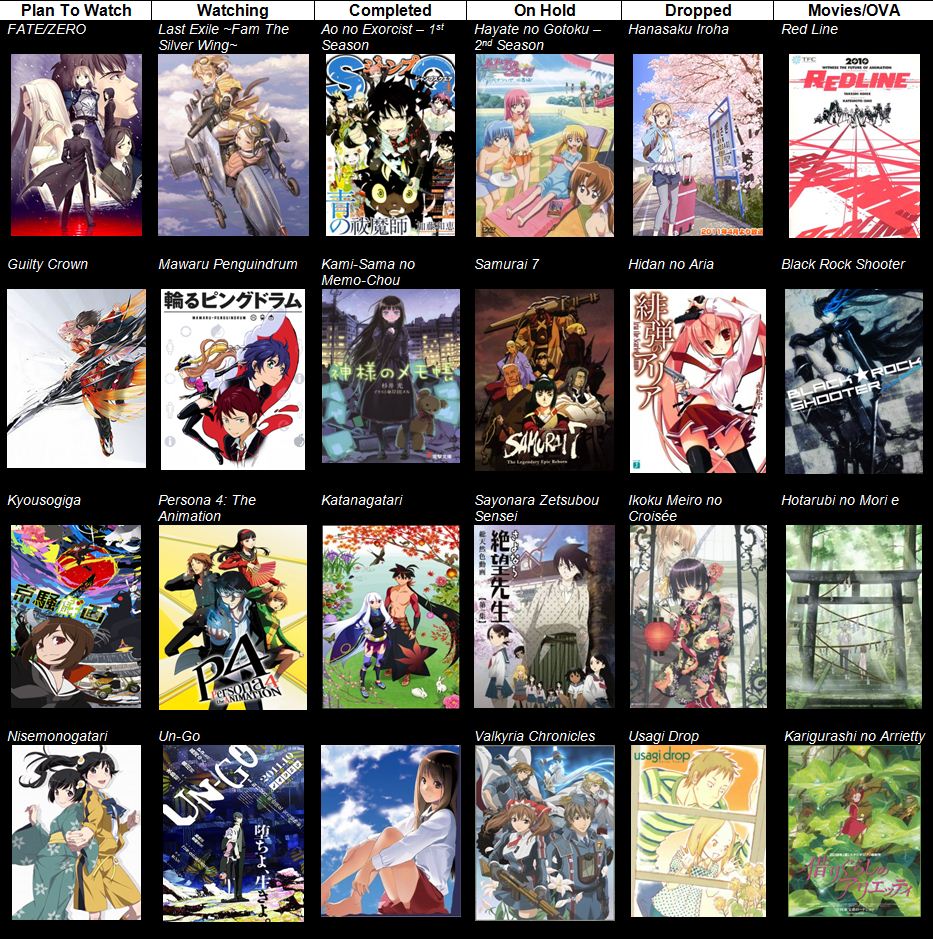
Today. I uploaded my new anime schedule for Fall/Winter 2011. Fall 2011 was kind of a let down for anime, but Winter 2011/2012 looks to be providing some really interesting shows such as Kyousogiga which looks to be a FLCL/Studio Ghibli/Summer Wars/Natsume Yuujinchou hybrid and of course a new season of Bakemonogatari, now labeled Nisemonogatari, and serving as what I understand to be a prequel to the main series. The PV for Kyousogiga rocks by the way and can be found here: http://www.youtube.com/watch?v=In4YoCWTKiM.


This weekend I marathoned Kanagatari, a 12-episode show, hard. Each episode is 50 minutes long, and I felt like a real hikikomori as I spent my Saturday in my room with the lights off, covered in blankets, watching Kanagatari and even refusing to answer the door when the doorbell rang. The art in Kanagatari is nothing short of amazing. One look at the opening sequences is a giveaway. The story, while heavily episodic, felt nicely paced especially given the 50-minute episode length and while I'm a sucker for samurai adventure narratives, Kanagatari was especially captivating.


The main character in Kanagatari, Shichika Yasuri reminds me a lot of Goku from Dragon Ball Z because of his upbringing outside of society, general cluelessness, and ability to never really sustain any serious injury. However, Goku is sadly more complex and enjoyable. Shichika remains, as he so often says, a sword or inanimate object throughout the series. He really only develops as a character against the backdrop of his flamboyant opponents, from the animal-themed Maniwa Corps to the eccentric owners of the Shikizaki blades. Honestly, how can you be in hot spring with a woman so casually?

While the fight sequences have a somewhat shounen-flair, action is definitely not a core part of Kanagatari. Don't let the cute character designs fool you as well. Kanagatari abhors violence as much as it vindicates it, with characters dying in bloody, brutal ways. One of the best qualities of Katanagari is how the show keeps you guessing. There is really no direct divide between good and evil in any sense in this show which is probably one of its most powerful points. Even the relationship between Togame and Shichika is never made clear, even by the end of the series. Either way, Kanagatari is definitely a show worth your while. Check it out for Thanksgiving Break.

Now for some A-Music!

1. San Francisco - Midicronica
Samurai Champloo ED26 Version


2. Tonight, Tonight, Tonight - Beat Crusaders
Bleach OP Version


3. Sea-Through Communication - School Food Punishment


4. Pride - SCANDAL


5. Tsukiakari no Michishirube - Stereopony
Darker Than Black: Ryuusei no Gemini OP Version


6. Tip Taps Tip - HALCALI
Eureka seveN ED Version


7. Loner - Outsider


8. Shinkokyuu - Super Beaver
Naruto Shippuden ED Version


9. Crazy Sunshine - The Pillows


10. じぶんROCK - ONEOKROCK

By That Time, You'll Already Be Torn To Pieces,
Noel